 November 17, 2025
In the construction trades, engineers and builders are constantly pursuing concrete mixes that provide greater durability and strength. Moreover, concrete adaptations that are biodegradable and nontoxic with reduced greenhouse gas emissions attract even more attention. The potential cherry on top of both would be if the adaptation could result in lower production costs.
 October 7, 2025
Researchers at George Mason University will collaborate on an NSF planning grant to develop resilience solutions and technologies. They will work with Indigenous communities, industry partners, government agencies, and six academic institutions.
 September 30, 2025
New George Mason University researcher goes beyond engineering to connect communities.
 July 30, 2025
George Mason University’s civil engineers are assessing the climate change challenges facing some of the world’s highest mountain ranges, creating better ways to measure the melting ice in high elevations where temperatures are rising faster than average and putting pressure on the livelihoods of fragile cultures and ecologies.
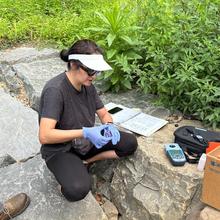 June 30, 2025
An intercollegiate study, in partnership with university Facilities, analyzes the effects of campus events and weather on local air and water quality.
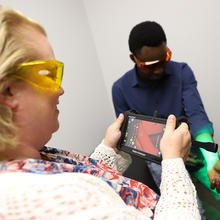 Groundbreaking mobile app captures and documents bruises to help survivors of interpersonal violenceJune 5, 2025
An interdisciplinary George Mason University research team is breaking new ground in using artificial intelligence to develop a mobile app to accurately capture and document bruises of victims of interpersonal violence.
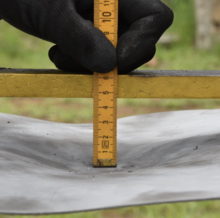 May 21, 2025
A partnership between the Brazilian Air Force and the College of Engineering and Computing is yielding explosive results in blast research, in what one faculty members describes as a win-win collaboration.
 November 1, 2024
With a new $3.69 million grant, the Research and Engagement for Action in Climate and Health (REACH) Center—which includes George Mason—is set to tackle the urgent intersection of climate change and public health in the nation’s capital.
 October 16, 2024
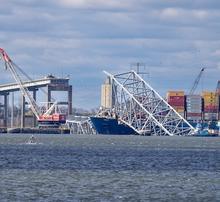
It was a day that residents in the Washington, D.C.-Baltimore metropolitan areas won’t soon forget: March 26, 2024, when the Baltimore Francis Scott Key Bridge collapsed, killing six and leaving many more forever impacted. Since then, George Mason University professors Elise Miller-Hooks, Alireza Ermagun, and Shanjiang Zhu have received two NSF RAPID grants to study the cause and impact of the collapse, and potential preventative methods for the future.
 April 29, 2024
Kirin Emlet Furst, in Mason's Department of Civil, Environmental, and Infrastructure Engineering, is using funds from an NSF CAREER award to measure the amounts of harmful "forever" chemicals in drinking water.
